
Comparisons • Research-based • Updated 7 October 2026
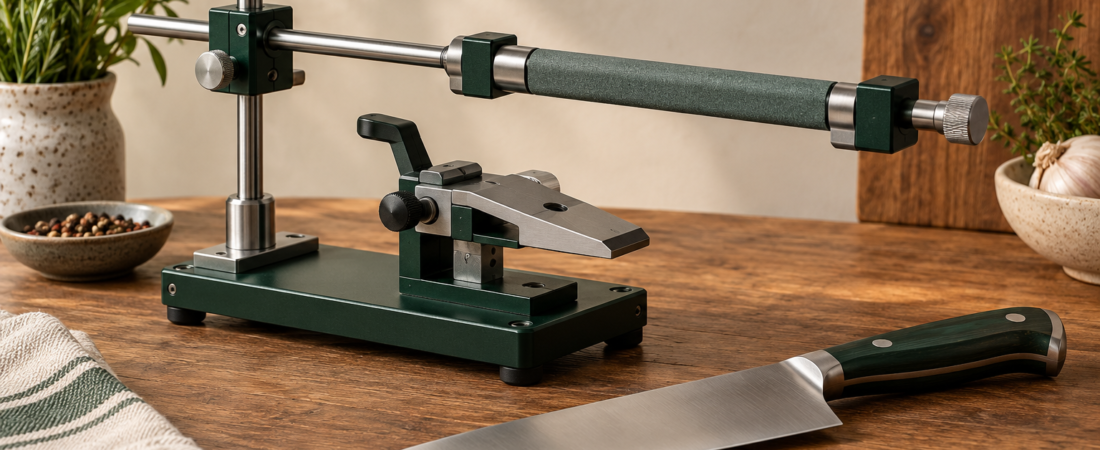
Featured image: AI-generated editorial illustration; not an exact product photograph or hands-on test.
Based on manufacturer information and editorial analysis. No hands-on testing claimed. Check the exact knife and tool manuals before use.
The fixed-angle vs adjustable knife sharpener decision starts with the angle your knives require. Extra settings help only when they cover that requirement. A fixed-angle tool can be a sensible purchase for a compatible collection, while an adjustable system can accommodate more specifications. Neither number of settings nor a fine scale guarantees a correct edge on its own.
Understand the terms
A fixed-angle system can offer more than one preset. An adjustable system allows a range or finer increments, but still has limits. Identify whether the stated number describes the angle on each side of the edge or the total included angle. Our angle explainer covers the terminology.
What you trade
| Factor | Preset system | Adjustable system |
|---|---|---|
| Setup choice | Select one of the supported settings | Set the required angle within the stated range |
| Mixed knives | Check that each knife fits a preset | Check range and holder fit for each knife |
| Repeatability | Record holder setting and placement | Record angle and placement, not just dial position |
| Added cost | May need another holder or method for exceptions | May include capability you never use |
Examples from actual tools
Work Sharp lists the original Precision Adjust at 15°–30°, while its RKS rolling system lists four preset angles. See the Precision Adjust specifications and RKS specifications. The systems also hold and reach blades differently, so the comparison cannot stop at their angle lists.
Placement still matters
A blade must be securely positioned and the abrasive must reach the intended edge without striking the holder. A narrow blade, pronounced taper or unusual handle can complicate that fit. Read the clamping or holder instructions before deciding that a supported number establishes compatibility.
If you change the knife position between sessions, record the new setup. A maintenance note can include the model, chosen setting and any maker-approved positioning detail. It gives you a starting point for the next session without encouraging you to rely on memory alone.
When more settings help
A mixed collection with several confirmed angle requirements is a stronger reason to buy adjustment than the possibility that you might own a different knife someday. If a single preset suits all the blades you maintain, spend the remaining budget on a complete kit and proper care. If it does not, price the alternative holder or separate method before checkout.
Avoid unnecessary reprofiling
Do not change an edge to fit a convenient preset simply because the tool is already in the drawer. Ask the knife maker before altering the original geometry. This article does not establish a best angle for your specific blade.
Use our Japanese knife buying guide for geometry checks and the beginner guide for workflow choices. Adjustable is a capability; the useful purchase is the one that fits your work.