
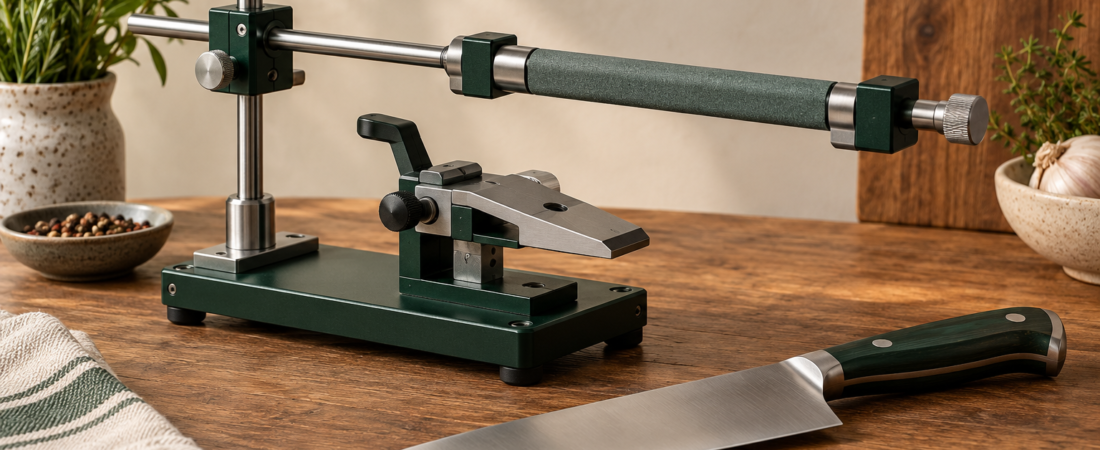
Featured image: AI-generated editorial illustration; not an exact product photograph or hands-on test.
Quick answer: The right knife sharpening angle starts with the specification for your exact knife. A sharpener with 15° and 20° settings offers two choices, but neither is automatically correct for every kitchen blade. Confirm whether the stated angle applies to each side of the edge or to both sides together.
Research-based guidance; no hands-on testing claimed. Sources checked 7 October 2026.
Knife sharpening angle: per side versus included
A double-bevel knife has an edge bevel on each side. On a symmetric edge, add those angles to find the included angle. This distinction matters when you compare a knife’s specification with a sharpener’s label.
| Angle on each side | Included angle for a symmetric edge |
|---|---|
| 15° | 30° |
| 16° | 32° |
| 20° | 40° |
The table is arithmetic, not a recommendation to change your knife. An asymmetric or single-bevel edge needs its own instructions; do not apply this doubling rule indiscriminately.
Why “Japanese” and “Western” are incomplete guides
A country or style label does not identify the factory edge of an individual model. Shun’s 2026 catalogue specifies 16° on each side for the cutlery covered by its sharpening guidance. Its care page also identifies a heavier-duty knife with a wider 22°-per-side edge. These examples show why an exact model specification is more useful than a broad regional rule. See the Shun/Kai catalogue and Shun care guidance.
How to choose between 15° and 20° settings
First identify the knife model, then find its care instructions. Next read the sharpener’s manual: check the angle terminology, supported bevel type, and any restrictions on blade dimensions or serrations. If the numbers differ, ask the knife maker whether that tool is appropriate.
For example, a knife specified at 16° per side does not exactly match either setting on a 15°/20° tool. Choosing the nearest number is still a decision to alter the edge. Decide whether you want to preserve the original geometry before buying a fixed-angle system.
Questions to answer before buying
- Does the maker specify the factory angle for this exact knife?
- Does the sharpener describe its settings as per side or included?
- Does it support this bevel, blade profile, and knife material?
- Is the goal routine maintenance or an intentional change of edge geometry?
If you cannot answer these questions, pause the tool selection and obtain the missing specification. Buying another abrasive does not resolve an unknown edge angle.
A practical compatibility example
Suppose your kitchen has three knives: a double-bevel chef’s knife with a known factory angle, a bread knife, and an inherited knife with no identifiable model. A shared handle style does not mean one sharpening slot suits all three. Make a separate compatibility decision for each blade.
For the chef’s knife, compare the documented angle with the tool’s setting. For the bread knife, look for explicit serrated-blade support and stage instructions. For the unidentified knife, obtain advice on its edge geometry before deciding on an abrasive. Keep a short record of the model, specified angle, compatible tool, and maintenance instructions so you do not need to repeat the research each time.
Angle choice and abrasive grade answer different questions. Use our whetstone grit guide to choose the sharpening stage, and our sharpening-frequency guide to assess when maintenance is needed.
Frequently asked questions
Is 15° always better than 20°?
No single angle is the right choice for every knife. Use the maker’s specification and intended cutting task rather than treating the smaller number as a quality rating.
Can I sharpen a single-bevel knife in a double-sided slot?
Do not assume compatibility. Check both manufacturers’ instructions for the exact knife and sharpener.
Related guides
Compare electric sharpener compatibility, explore the sharpening-stone buying guide, or review honing versus sharpening.