
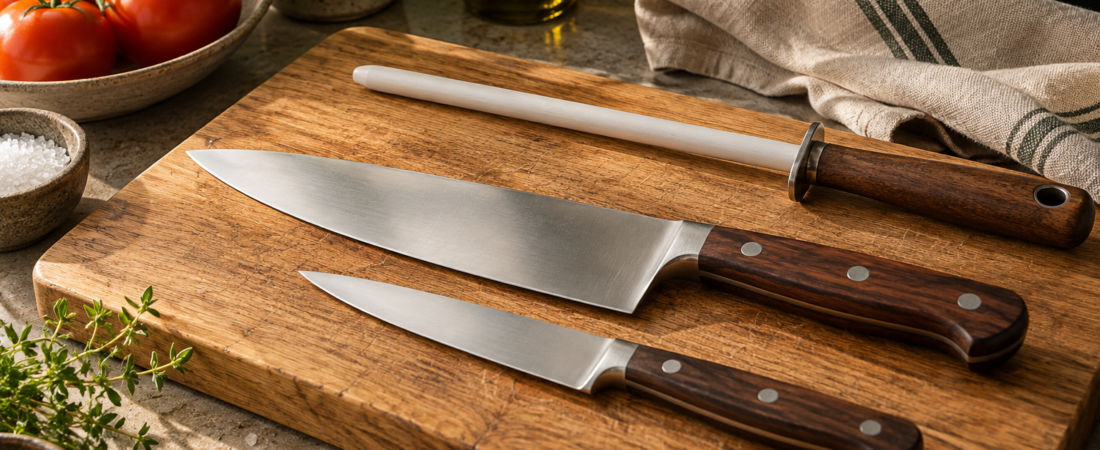
Featured image: AI-generated editorial illustration; not an exact product photograph or hands-on test.
Quick answer: There is no single sharpening schedule for every kitchen knife. If you are deciding how often to sharpen kitchen knives, use the knife maker’s guidance and changes in cutting performance. Keep routine maintenance and full sharpening separate in your plan.
Research-based guidance; no hands-on testing claimed. Sources checked 7 October 2026.
How often to sharpen kitchen knives: calendar versus condition
Shun suggests that once or twice a year is sufficient for most home cooks using its knives, while noting that frequency depends on cooking habits, technique, and cutting surface. That is guidance for its products, not a timetable for all knives. Source: Shun’s knife-care article.
A practical routine is to inspect and assess a knife regularly, then sharpen when its condition calls for it. A calendar reminder can prompt the assessment without automatically becoming a sharpening appointment.
Look for a change in familiar cutting tasks
Shun’s FAQ identifies diminished tomato-skin cutting after honing, uneven performance along the blade, and corrosion as reasons to seek sharpening or service. Its guidance also distinguishes maintenance with a honing steel from metal removal during sharpening, and cautions that diamond steels remove metal. Source: Shun FAQ.
For your own kitchen, choose a familiar food-preparation task as a reference. Notice whether the knife behaves differently from when it was in good condition. Stop if cutting requires uncomfortable force or control becomes uncertain. Do not use a finger along the edge as a sharpness test.
Record the problem before choosing the tool
- General dullness: note whether the change affects the whole cutting edge.
- Uneven cutting: note whether a particular part of the blade is performing poorly.
- Visible damage: photograph chips, a bent tip, or corrosion for the maker or sharpening service.
- Unknown compatibility: identify the model and its recommended maintenance method before using an abrasive.
This record helps you ask a useful question: “This section stopped cutting well after the recommended maintenance; what service or tool is appropriate?” It is more informative than “How many passes should I use?”
Check performance instead of chasing a pass count
The Chef’sChoice Model 478 manual recommends comparing food cutting before and during sharpening, seeking a clean cut without excessive force or crushing. Its instructions apply to that specific sharpener; they are not a universal procedure for other machines or stones. Source: Model 478 manual.
Keep the tool’s manual with your maintenance notes. Record what you used, when you used it, and whether it restored performance. If it did not, obtain advice before repeating an unproductive routine.
Make a simple maintenance record
For each knife, note its model, recommended maintenance tool, last sharpening date, and what changed in cutting performance. Keep sharpening and honing entries separate so the record describes what actually happened to the edge.
When a familiar knife starts cutting poorly, compare the new behavior with those notes. A recurring problem deserves a closer look at the tool, technique, and blade condition. Sending a clear description to the maker or sharpening service can be more useful than repeating the same passes.
If sharpening is needed, check our knife sharpening angle guide and whetstone grit guide before selecting a method.
Frequently asked questions
Should I sharpen every week?
Do not adopt a weekly abrasive routine simply because it is easy to remember. Base the decision on your knife’s guidance and condition.
What if recommended honing does not help?
Reassess the edge and consider sharpening or professional service. Check the knife’s requirements before selecting a tool.
Pick the next step, not a new sharpening schedule
- Abrasion is needed and you want a bench setup: compare the stone buying guide and Shapton 1000 review.
- You want guided manual work: check blade fit and the angle range in the original Precision Adjust review.
- You want powered maintenance: use the electric sharpener guide to check supported angles and procedures.
- There is damage, corrosion or uncertain geometry: seek the knife maker’s advice or a qualified service before buying another abrasive.
Keep your assessment notes with the tool’s manual. A suitable tool helps with the required task; owning it does not make more frequent sharpening necessary.
Related guides
Read honing versus sharpening, the knife-care overview, and the electric sharpener selection guide.